What You Got
Don't waste what you have, and find a way to make more from it.

Did you know that 2Pac the rapper and Paul the apostle preached the same message? Don't believe me? Bet. Let's start with one of my favorite passages penned by Pac.
Dear Mama, by Tupac Amaru Shakur
And I could see you comin' home after work late,
You're in the kitchen trying to fix us a hot plate
You're just workin' with the scraps you was given
And mama made miracles every Thanksgiving
In his letter to his mother, 2Pac called us to nod our heads at a scene many of us knew by heart. A mother, weary from a day's work, made full meals from an almost barren pantry and refrigerator. That was the result of traditions passed down from generation to generation, originating from enslaved Africans who were shipped to the South. The enslaved were given leftovers and the parts of animals that the slave owners refused: such as the ears, skin, intestines, and feet of pigs. The quality and quantity of rations would vary, so slaves had to think carefully about their meals. After slavery ended, the impact of it remained. Time progressed, and economic hardships were introduced. Black people didn't have the same financial opportunities and assistance as their White counterparts. This is not to say that all White people were rich; they were under the same economic climate as all Southern Americans, but Black people were hit harder. This meant they were bound to what they could afford, which was still the less desired meat and produce.
So we couldn't waste what we had, and we had to find a purpose for what was left. Soul food was born.
Now let's flip to one of my favorite passages penned by Paul.
Ephesians 2:10 CSB
For we are his workmanship, created in Christ Jesus for good works, which God prepared ahead of time for us to do.
In his letter to the church at Ephesus, Paul causes us to bow our heads at a scene many of us would experience in our heart. The Creator purposefully made all that we see by speaking and crafting. He saved His greatest creation for last: children who were made in His image and in His likeness. And at the time He was making the first man and woman, He was thinking about you and me, and He architected work for us to do that He would call good. Everything God does is intentional, and nothing He has ever thought to make is wasted.
God does not waste good works or situations, and if we're His workmanship, then we shouldn't either.
Pac preached about his mom making miracles with what she was given, and Paul preached that God created us by the Son Who was given. Pac's mom prepared him to make a dollar out of fifteen cents, and God prepared us to produce fruit of His Spirit.
Same message: don't waste what you have and find a way to make more from it.
As creators, we must be faithful inside the work while we are in it, because our best work is aligned to the good works God intended.
Don't leave it
There's an ugly truth to this beautiful story: some of our best work comes from our worst situations. Paul also wrote:
Galatians 5:22–23 CSB
But the fruit of the Spirit is love, joy, peace, patience, kindness, goodness, faithfulness, gentleness, and self-control. The law is not against such things.
The good works that God intended for us are connected to Him. We are to produce fruit, but not just any fruit: we're called to produce fruit of the Spirit. That fruit consists of nine characteristics that any sane person would value. Who wouldn't want to work with someone with those qualities? But look at what stands opposite the fruit.
| The Fruit We Want | The Opposition We Avoid |
|---|---|
| Love | Hatred |
| Joy | Despair |
| Peace | Strife |
| Patience | Outbursts of Anger |
| Kindness | Cruelty |
| Goodness | Corruption |
| Faithfulness | Betrayal |
| Gentleness | Harshness |
| Self-control | Excess |
A child doesn't want a mother with hatred in her heart and no love. People appreciate working under the guidance of a manager with patience but don't want to tolerate one with outbursts of anger (because, first of all, who you yelling at?). A dude wants a best friend who is faithful, but he'll avoid a guy who is known for betrayal. Patrons appreciate sitting next to someone with joy, but no one wants to hang around someone full of despair. Unless your name is Misery, because that's the only person who loves that company.
But do you know what is needed at the table where harshness rules? Gentleness. Patience isn't patience until someone is testing it. Gentleness is valued when it's given to someone who doesn't deserve it. A board of corrupt business people is desperate for a director who is full of goodness. The characteristics in the table above sitting opposite to the fruit can't be the people we avoid; it's the working conditions. Unlike a farmer's produce, the fruit of the Spirit does its best growing when it is planted in the soil of an otherwise unkempt garden.
Jesus said, "you will have suffering in this world" (John 16:33). Your love is going to be met with hatred. Your self-control will be surrounded by people who deliberately live in excess. In order to achieve good works, we sometimes have to endure undesirable circumstances. But we will get through it, because Jesus ends that verse with, "Be courageous! I have conquered the world!"
But I have learned that whenever we go through something and we achieve something, even if we move beyond the work, we don't move beyond the lesson. Because the lesson we learned is what can be used in the future.
That mother preparing a dinner where the family was full and couldn't eat anymore was normal. Throwing away the leftovers instead of saving it would be the waste. Moving on from a job, a season, or a role is normal. Moving away from what the job, season, and role taught you is the waste. You work, you learn, and then you work what you learn. Learn from it, but don't leave it. That's called a creative portfolio.
The two portfolios and the third option
A financial portfolio shows money that is currently at work. It shows what was invested, where, and what it has gained or lost. That portfolio has worked, is working, and will continue to work. Even if the person who owns the portfolio is not actively taking funds from their checking account and putting it into an investment opportunity, the work is still happening. The defining property is that it keeps working whether or not the owner is adding to it today.
A career portfolio, as most people have built it, does the opposite. It's but a record of work that has stopped. This portfolio is the testament of "While I worked at this company, I achieved this status by implementing this project, and here are the receipts." The portfolio becomes that: a glorified shoebox of receipts. It shows what we previously did.
Portfolio. Same word, but two behaviors. One keeps earning while you sleep. The other sits in a box in a closet, proving that you once earned. I'd argue that we should take a hint from the financial portfolio and build a career portfolio that continues to work for you. That is the third option.
If we know that our best work is aligned to the good works that God intended, we will strive to continue to do our best work. Not because we are working for acceptance; we're working from acceptance. God already planned for us to do them, and He knew they would be activated through faith in Christ Jesus. That makes us already worthy. So we can create boldly, and we create in the image of a God who does not waste.
Practically it looks like this:
- We do the work
- We face opposition in doing our best work
- Our best work was intended to overcome that opposition
- We learn as we overcome
- We move on to new work once the opposition has been resolved
- We apply what we learned to make our work even better
- We do better work
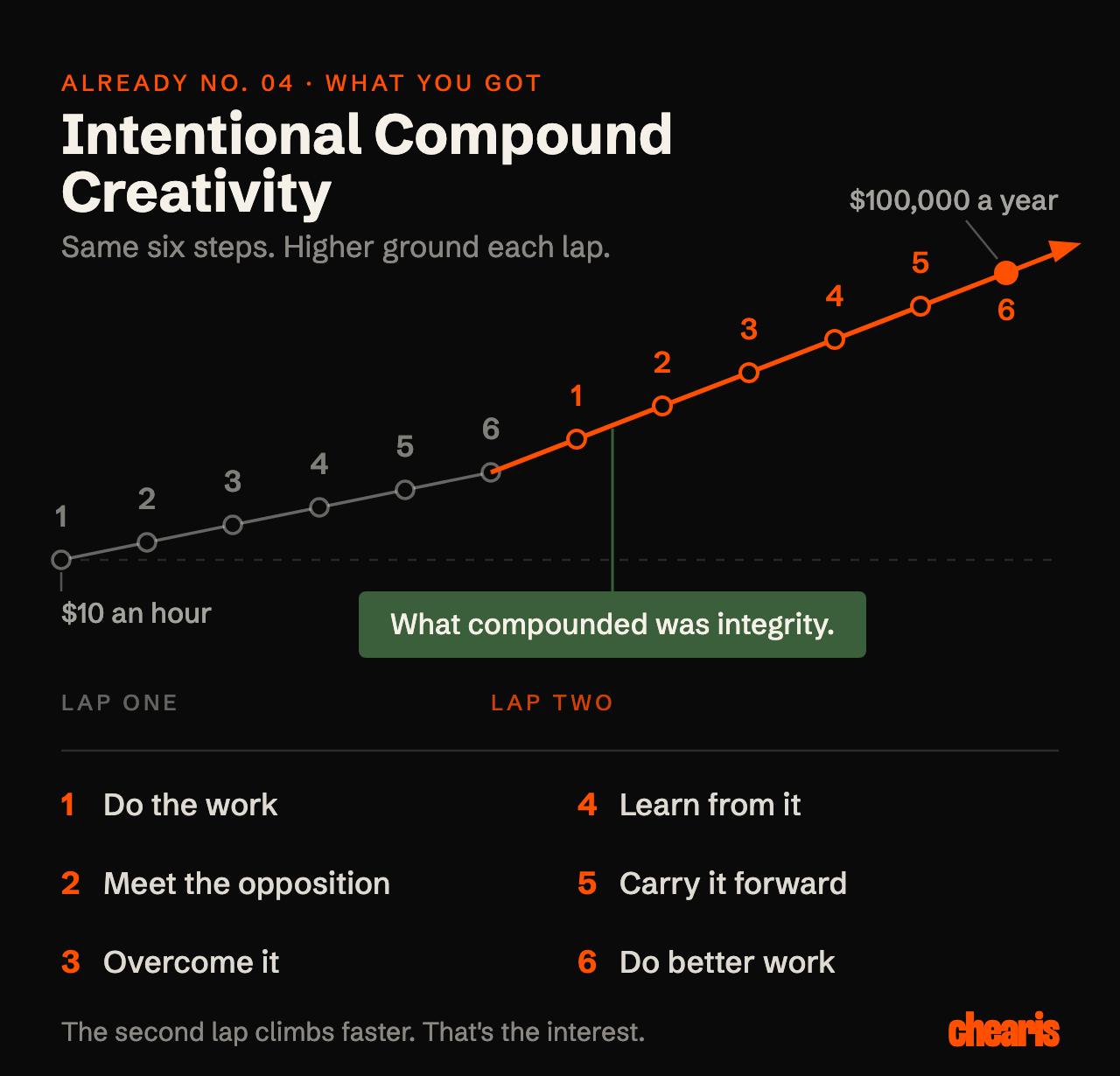
That system is called Intentional Compound Creativity. It's intentional because that is what we have to be in using what is in our creative portfolio. It's compounded because over time, the value of what we have created and what we are creating will increase. Intentional is the requirement placed on the maker. Compounded is the return that the maker collects.
Drifting towards being deliberate and distinguished
I end this essay with the toughest pill to swallow. It takes work to do the best work God already intended. Predestined work doesn't mean it will feel like it's yours while you're walking towards it. Facing opposition is hard, overcoming it is harder, and growing better instead of bitter is the hardest. You grow better and not bitter by learning and making yourself apply what you learned.
You have to find reasons and ways to use what you've learned. Doing so will not only bless you, but you'll ultimately uncover additional lessons in the lesson. I called a customer ugly because she chose to fight me instead of let me help her. The lesson was that I had to stay cool under pressure. I couldn't let people get under my skin and cause me to lash out, which would mean that I would lose my job. I took that principle and applied it at the next job. I faced even ruder customers, because the clientele was wealthier. But that unlocked new lessons: no amount of money in your bank account alleviates hatred in your heart. I knew that eventually I would be able to afford the clothes and goods that I sold to the wealthy, and I refused to treat the cashier who helped me like I was treated.
I can see that the lessons I learned making a few bucks an hour would be the foundation on which I would stand when I received a salary of six figures. If my integrity wouldn't bend for $10 an hour, it wasn't going to bend for $100,000 a year.
Integrity was the compounded interest in me investing in the lesson of patience. No one drifts towards being deliberate with their time and distinguished in their creativity. Getting there takes intention. But take heart: God always intended for you to get there.
Receipts
- Sharecropping — History of Racial Injustice — Equal Justice Initiative, accessed 2026-08-03.